
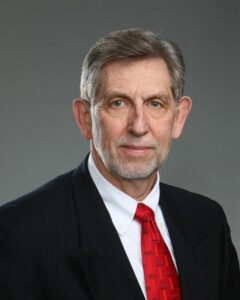
The Call Back Home
Before Dr. Walter Grubb ever served at The King’s Academy, the story had already reached into his family.
Years before he stepped into leadership, before the move from California, before the difficult first year, before the name The King’s Academy became the identity so many know today, there was Harrison Chilhowee Baptist Academy. And for the Grubb family, that name meant something personal.
Dr. Grubb was born in 1951. His father had left high school in the tenth grade, but later came to faith in Christ and felt called to preach the gospel. That calling eventually led him back to the classroom.
Not to college. Not to seminary yet. First, to high school.
He returned to Harrison Chilhowee Baptist Academy as an adult, with children at home, and sat in classrooms with teenagers so he could finish what he had started years before. Dr. Grubb remembers it plainly:
"I saw my father graduate from high school."
That is not something many sons can say.
At the time, his father was not alone. During the 1940s, 1950s, and into the 1960s, Harrison Chilhowee served a number of ministers, often called “preacher boys,” who had entered ministry without a high school diploma. Some came with wives. Some came with children. They sat beside students much younger than themselves because a diploma mattered, and because they believed preparation mattered.
For Dr. Grubb, his father’s example left a mark.
His father later attended Carson-Newman and eventually moved the family to California so he could attend Golden Gate Baptist Theological Seminary in Mill Valley. Through every season, he kept learning. He pastored small churches, drove long distances, continued his education, and quietly set a standard for his children.
That was Dr. Grubb’s first connection to the school.
Then, for many years, the academy moved to the background of his life.
There was one brief possibility in 1974. Dr. Grubb and his wife had moved from California to Tennessee so he could attend graduate school at the University of Tennessee. Through a family connection, he was introduced to Hubert Smothers, who was serving as president of the school at the time. There was a conversation about Dr. Grubb and his wife possibly serving as dorm directors in the boys dormitory.
They were newly married. The timing did not feel right. They declined.
Still, Dr. Grubb remembered meeting Hubert Smothers. He remembered his personality. He remembered thinking he would like to work for a man like that.
But the school remained, for the most part, a distant part of his story until 1987.
By then, Dr. Grubb had spent more than two decades in California. He attended California Baptist College, now California Baptist University. He met his wife there. He worked in Christian education, served as a teacher, became a principal, worked at the college level in admissions and student life, and later served in an intense special education program in Riverside.
Education had not been his original plan.
He had studied political science and once imagined a future in government. But after graduation, he discovered what many college graduates discover. No one was waiting at the edge of the stage with a perfect job offer.
Then a door opened at a private Christian school in Riverside. He began teaching history, math, and art. Something clicked.
“I realized, oh my goodness, this is where I’m supposed to be,” he recalled.
That realization changed the direction of his life. He pursued graduate work in education, became certified as a teacher, then as an administrator. His heart remained close to the classroom, even as his responsibilities moved him toward leadership.
Then came the phone call.
In the summer of 1987, Dr. William Palmer, then president of the academy, called Dr. Grubb in California. Dr. Palmer was looking for a principal. Dr. Grubb’s father, who had graduated from the academy and later served on the Board of Trustees, had mentioned his son.
Dr. Grubb laughs about that detail now, calling it “a little nepotism at play.” But the call itself was no small thing.
“His phone call changed my life,” he said.
Dr. Palmer invited him to come to Tennessee for a visit. Dr. Grubb and his wife talked it through, and she was open to the move. That mattered. California was home for her. They had a son who was eight years old and another child on the way. This was not a small adjustment.
Dr. Grubb flew to Tennessee, stayed with his parents in Maryville, and drove to the academy for a Sunday afternoon interview.
During that interview, Dr. Palmer offered him the job.
Dr. Grubb accepted immediately.
The weight of it did not fully hit him until the drive back to his parents’ house. Somewhere along the road, he became so overwhelmed that he had to pull over. He sat there and tried to take in what had just happened.
He had no doubt.
He described it as one of the strongest senses of God’s leadership he had ever experienced. Not a vague feeling. Not a passing emotion. A clear conviction.
God was saying yes.
So he came.
When Dr. Grubb drove onto the campus, he did not see a polished, easy assignment. He saw old buildings. A small student body. A school with deep history and real needs.
He also saw possibility.
The campus sat on 65 acres in the foothills of the Great Smoky Mountains. The school had already been serving students for more than 100 years. Students were coming from around the world. There was beauty here, and there was history here, but there was also a lot of work to do.
His honest thought was simple: “Buckle your seat belt. This is going to be a ride.”
And it was.
The first year was harder than he expected.
The school was serving around 100 students in grades 8 through 12. The campus was large and aging. Facility needs were obvious. Faculty development was needed. Finances were tight, even with support from the Tennessee Baptist Convention, which at the time provided a much larger percentage of the school’s budget than it does today.
There was also a cultural adjustment.
Dr. Grubb had spent years in Southern California. East Tennessee moved at a different pace. Education moved slowly. Baptist life moved slowly. And at Harrison Chilhowee, all of those realities met in one place.
He did not come in trying to change everything overnight, but he did come with ideas. Some people were unsure of him. Some faculty members wondered what to make of this new principal from California. Trust had to be earned.
That took time.
Dr. Grubb had to show teachers he was not there to threaten them. He was there to support them. They needed time to trust him, and he needed time to trust them.
Looking back, he can see moments when he wanted to move faster than he should have. There were people he thought might need to leave. His instinct may have been to force the issue, but he did not believe the Holy Spirit gave him freedom to do that.
Over time, people moved on. Others came in. The school began to find the right people for the right seats.
The work was still hard. There were moments when Dr. Grubb wondered what he had gotten himself into. He wondered why he had moved his family across the country. He even admits there were times he wanted to quit and go back to California.
But the conviction from that interview day stayed with him.
He believed he was supposed to be here.
That conviction was one reason he stayed. The people were another.
Dr. Grubb remembers teachers who were among the best he had ever seen. He remembers board members who gave sacrificially, prayed faithfully, and cared deeply about the school. Slowly, the people of the academy won him over.
Then came his first fall on campus.
After years in California, where the seasons looked different and green often had to be watered into existence, autumn in East Tennessee struck him with unusual force. The campus was covered in color. The mountains, the trees, the setting, all of it felt almost impossible to take in.
He mentioned it to his father.
His father’s response was simple: “Son, it’s like that every fall here.”
That comment did more than explain the season. It reminded Dr. Grubb where he was.
He was not just at an old school with aging buildings and financial challenges. He was not just at a place with a long history and a complicated present.
He was at a special place.
And, though he could not yet see all that would come, he was exactly where God had called him to be.